8 Min Read
Beyond Stockouts: Why Clinical Supply Organizations Need a Resilience Score
Clinical supply disruptions are rarely unexpected they are often the result of risks that were visible but not measured. This blog examines how a Clinical Supply Resilience Score helps organizations identify vulnerabilities early, mitigate stockout risk, and build a more resilient clinical supply network.
Executive Summary
Clinical supply disruptions rarely occur without warning. In most cases, the underlying vulnerabilities already exist across supplier dependencies, inventory positioning, distribution networks, and operational readiness. The challenge is not the absence of data; it is the inability to translate fragmented risk signals into a clear measure of organizational resilience.
Unlike commercial supply chains, clinical trial supply networks operate within a highly regulated environment where corrective actions often require formal regulatory review. As a result, vulnerabilities identified today may take months to resolve, significantly increasing exposure to operational and patient risk.
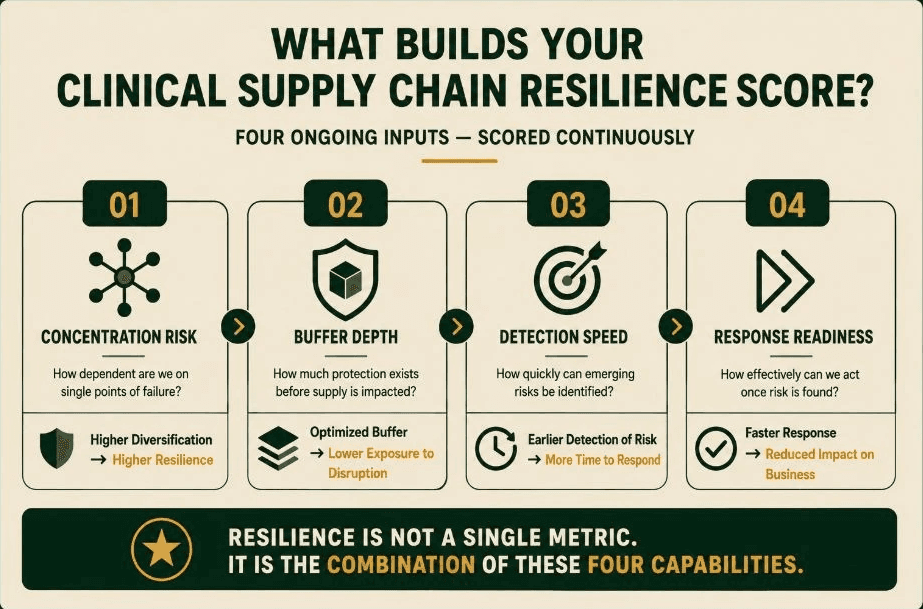
A Clinical Supply Resilience Score provides a real-time measure of how well an organization can anticipate, absorb, and respond to disruption. It transforms resilience from a discussion point into a quantified, managed capability.
Organizations that proactively measure resilience can reduce stockout risk, improve decision-making, strengthen supply continuity, and support more predictable clinical trial execution.
Key Takeaways
Most stockouts are preceded by visible warning signs.
Supplier dependencies, depot constraints, transportation delays, and inventory vulnerabilities often exist long before disruption occurs.
Clinical supply chains face extended recovery timelines.
Corrective actions frequently require regulatory approval, making rapid mitigation significantly more difficult than in commercial supply environments.
Resilience should be managed as a KPI.
Organizations routinely measure enrollment, inventory, and forecast performance, yet few maintain a continuous measure of supply chain resilience.
A Resilience Score enables proactive risk management.
Leadership teams gain visibility into emerging vulnerabilities before they impact patients, sites, or study timelines.
Context and Stakes
Clinical trial supply chains have become increasingly complex. Global studies rely on interconnected networks of manufacturing sites, packaging facilities, depots, logistics providers, and country specific regulations. Every additional dependency introduces execution risks and potential points of failure.
At the same time, study designs continue to evolve. Adaptive protocols, decentralized trial models, accelerated enrollment patterns, and expanding global footprints have increased operational complexity and reduced tolerance for disruption.
In this environment, even seemingly minor vulnerabilities can have significant consequences. Individually, these risks may appear manageable.
A delayed shipment that narrows the dosing window.
A manufacturing deviation that constrains available supply.
A single-source supplier dependency that limits response options.
An inventory buffer that looks sufficient until enrollment accelerates.
Collectively, they can create conditions that lead to a stockout, delayed site activation, protocol deviation, missed patient dose, or loss of confidence in trial execution.
The challenge for leadership is not only detecting individual risks. It is understanding how those risks interact and determining the organization’s overall resilience before disruption occurs.
Why Clinical Trials Require a Different Approach to Resilience
Commercial supply chains are built for flexibility. Suppliers can be changed, routes adjusted, and inventory policies recalibrated quickly in response to emerging risks.
Clinical trial supply chains are not.
They operate under stricter regulatory constraints, where changes to manufacturing, sourcing, packaging, or distribution often require formal approval taking weeks or even months to implement.
This creates a critical exposure window.
The highest risk is not before a vulnerability is discovered, but after it is identified and before it can be resolved. Organizations may have full visibility into a weakness yet remain exposed due to regulatory and operational constraints.
For leadership, this changes the equation.
Resilience is not about reacting to disruption; it is about detecting risk early, continuously monitoring exposure, and acting within the limits of the system.
This is precisely where a Clinical Supply Resilience Score creates value, turning fragmented risk signals into a quantified view of exposure, enabling earlier decisions, faster mitigation, and more reliable trial execution.
Strategic Benefits of Measuring Resilience
Organizations that actively measure resilience go beyond managing risk; they build a competitive advantage.
Earlier Risk Visibility
Identify emerging disruptions before they impact clinical operations.
Stronger Executive Decision-Making
Equip leadership with a clear, defensible metric to assess and act on operational exposure.
Faster Mitigation
Prioritize and address the highest-risk vulnerabilities before they escalate.
Improved Supply Continuity
Reduce stockout risk and ensure uninterrupted patient dosing and study execution.
Continuous Improvement
Embed resilience as an operational capability measured, benchmarked, and strengthened over time.
Illustrative Scenarios
Scenario A: Manufacturing Dependency Risk
A late-stage clinical program relies on a single manufacturing facility. Resilience assessment identifies elevated concentration risk early, prompting qualification of a secondary source ensuring continuity when production challenges arise.
Scenario B: Depot and Distribution Exposure
A regional depot experiences recurring transportation delays. Resilience monitoring detects rising exposure driven by increased enrollment and limited buffers, enabling proactive inventory repositioning before site impact.
Scenario C: Limited Visibility Environment
A sponsor lacks end-to-end visibility across its supply network. With resilience monitoring in place, detection times improve significantly, allowing faster intervention and reducing operational risk.
Conclusion
Clinical supply organizations have no shortage of metrics, enrollment, inventory, forecast accuracy, and site activation timelines and many others.
Yet one critical question often goes unanswered:
How resilient is the supply chain today?
Most disruptions are not caused by a lack of information. They occur because risk signals remain fragmented, unmeasured, and disconnected until they escalate into operational events.
A Clinical Supply Resilience Score changes that.
It provides leadership with a continuous, quantified view of exposure enabling earlier decisions, faster mitigation, and stronger supply of continuity across clinical programs.
For executives, the value is clear:
Fewer disruptions through earlier risk identification
Better decisions driven by a single, defensible metric
Stronger continuity across trials, sites, and patients
Greater predictability in timelines and outcomes
In clinical trials, the organizations that lead are not those that react faster, but those that measure and act on resilience before disruption occurs.
Therefore, Clinical Supply Chain Resilience isn’t optional it’s what separates controlled execution from costly disruption
Connect CMS Image fields (Image 1–10)
Similar Blogs



Take Action
Learn how Boston Insights equips you to anticipate risk, act faster, and keep patients on schedule.
FAQs
Answering your questions
We know trying a new platform comes with questions. From setup to security, integrations, and outcomes, here’s everything you need to know about how our solutions work and why they’re trusted by teams like yours.